Friday, January 13, 2023

Thaddeus Stevens Chronicles No. 25

 Thaddeus Stevens and the drive for the 13th Amendment

January 2023

By Ross Hetrick

One hundred and fifty-eight years ago this month, the 13th Amendment, which abolished slavery, was barely passed in the House of Representatives, which was surprising considering that all of the ardent supporters of slavery from the south had long left the House to fight for a new country dedicated to slavery.

One of the strongest supporters for that amendment was Thaddeus Stevens, who had worked for more than 40 years to see slavery destroyed.

"What an opportunity is presented to this Republic to vindicate her consistency and become immortal," Stevens said in January 1862, years before the amendment was passed. "The occasion is forced upon us, and the invitation presented to strike the chains from four million of human beings, and create them MEN; to extinguish slavery on this whole continent; to wipe out, so far as we are concerned, the most hateful and infernal blot that has ever disgraced the escutcheon of man, to write a page in the history of the world whose brightness shall eclipse all the records of heroes and sages."

But the amendment was not preordained. In fact, the first attempt at a 13th Amendment was actually a sinister effort to appease the South by further enshrining the horrid institute in the Constitution.

As southern states were leaving the Union in early 1861, the House and the Senate approved a Constitutional amendment that would have barred any amendment that would interfere with slavery. Called the Corwin Amendment after its sponsor, Rep. Thomas Corwin of Ohio, it was signed by outgoing President James Buchanan, even though a presidential signature was not needed.

The measure went on to be approved by the states of Kentucky, Ohio, Rhode Island, Maryland and Illinois. Even Abraham Lincoln said he had no objection to the Corwin Amendment. But to be fair to Lincoln, he and most abolitionists conceded slavery was completely protected by the Constitution and the new amendment would make no difference.

But the proposed amendment did not dissuade the South from leaving. Their main objection was that Lincoln and the Republican party were against the expansion of slavery into new states, a position they would not compromise on.

Stevens and other congressmen submitted amendments to abolish slavery in the spring of 1864, and while the measure passed in the Senate, it failed in the House where it was 13 votes short of the necessary two-thirds vote. Then in December 1864, Lincoln got behind the effort publicly and the amendment squeaked through the House by the end of January with only three votes to spare.

Even with Lincoln support, the effort to approve the amendment was a monumental legislative struggle, as shown in the 2012 movie Lincoln. Democrat George Pendleton of Ohio was the chief defender of slavery and accused Stevens and his allies of causing the Civil War. Stevens responded by saying Pendleton's epitaph should be, "Here rests the ablest and most pertinacious defender of slavery and opponent." In contrast, Stevens said he would be satisfied if his tombstone read:  "Here lies one who never rose to any eminence, and who only courted the low ambition to have it said that he had striven to ameliorate the condition of the poor, the lowly, the downtrodden of every race and language and color."

Ross Hetrick is president of the Thaddeus Stevens Society, which is dedicated to promoting Stevens's important legacy. More information about the Great Commoner can be found at the society's website: https://www.thaddeusstevenssociety.com/


Monday, December 12, 2022

Thaddeus Stevens Chronicles No. 24

 Thaddeus Stevens on honoring Confederate dead

December 2022

By Ross Hetrick

Shortly after the Civil War, Thaddeus Stevens said honoring the Confederate dead along with the Union casualties was "blasphemy."

"If the loyal dead, who are thus associated with the traitors who murdered them, [are] put on the same footing with them, are to be treated as the 'common dead of the nation,' " Stevens said, then the Union dead would break out of their graves and haunt the advocates of that policy, until their "eyeballs were seared."

No graves were opened nor eyeballs seared at the Remembrance Day parade on November 19 in Gettysburg, but Stevens and others on the Union side would be gravely dismayed to see hundreds of Confederate reenactors marching in the street with many on the sidelines cheering them on.

Gettysburg has the unusual situation of having two Civil War events in November that sometimes coincide and sometimes are days apart. One is Dedication Day when the immortal speech by Abraham Lincoln is celebrated at the Gettysburg National Cemetery on November 19. The other one is Remembrance Day, when Union and Confederate reenactors parade through town to honor Civil War dead on both sides. Remembrance Day is on the Saturday closest to the 19th. So while they are not the same thing, most people often see them as marking Lincoln's Gettysburg Address.

This year, 2022, both events fell on the 19th so people were treated to the sight of Confederate reenactors proudly parading while others honored Lincoln, who was cut down by a Confederate agent.

While most people accept the irony without comment, Scott Hancock, a Gettysburg College professor, boldly walked along the side of the Confederate reenactors holding a sign pointing to them saying: "This Army Fought for Slavery." This was the latest public effort by Hancock to inform people about what the Confederacy was fighting for.

"As long as Confederate reenactors with Confederate flags march on Remembrance Day," Scott said recently, "somebody needs to be reminding spectators that if Black people had not been enslaved, there would have been no Confederacy, no Confederate Army, no battle at Gettysburg, and no American Civil War." 

While opponents of honoring the Confederacy have gained ground in recent years as shown with the removal of  monuments around the country, Confederate defenders remain strong as evidenced by the Remembrance Day parade. The remarkable dedication of these people to defend an inhuman system dates back to long before the Civil War.

"Even in a bad, a wicked cause, she shows a united front" Stevens said of southern representatives in an 1850 speech. "All her sons are faithful to the cause of human bondage, because it is their cause. But the North -- the poor, timid, mercenary, driveling North -- has no such united defenders of her cause, although it is the cause of human liberty. None of the bright lights of the nation shine upon her section. Even her own great men have turned her accusers. She is the victim of low ambition -- an ambition which prefers self to country, personal aggrandizement to the high cause of human liberty. She offered up as a sacrifice to propitiate southern tyranny -- to conciliate southern treason."

But there was Thaddeus Stevens.

Ross Hetrick is president of the Thaddeus Stevens Society, which is dedicated to promoting Stevens's important legacy. More information about the Great Commoner can be found at the society's website: https://www.thaddeusstevenssociety.com/


Friday, November 18, 2022

Thaddeus Stevens Chronicles No. 23

 Thaddeus Stevens and the Gettysburg Address

November 2022

By Ross Hetrick

Asked why he and other prominent politicians were not going to attend Lincoln's speech in Gettysburg, Thaddeus Stevens said, "Let the dead bury the dead."

Stevens quoted this enigmatic Biblical passage because he thought  Lincoln was politically dead at the time and would not be re-elected president. But near the end of 1864, battlefield victories came in fast and furiously and Lincoln won a second term, only to be cut down a month into his new term.

It's too bad that Stevens didn't go to Lincoln's immortal address. Perhaps he could have shown Lincoln around Gettysburg, where he had lived for 26 years, and some of the fame of the event would have rubbed off on him. Despite his legendary ability of persuasion, Thad could have used a good PR consultant some times. 

One thing Lincoln's speech established for all time is the truth that "brevity is the soul of wit." Edward Everett's two-hour speech at the same event is long forgotten and only brought up as an example of wordiness.

In an age when marathon speeches were common, Stevens's orations were distinguished for being short, eloquent and to the point. While none of his speeches were to become as well know as the Gettysburg Address, Stevens poetically summed up his political principles on June 13, 1866 just before the passage of the 14th Amendment in Congress. The measure, which he introduced, promised to fulfill the long delayed promise of all people are created equal and extend the protection of the Bill of Rights to the state level. And even though it was his creation, he was dissatisfied with the way it had been changed, particularly on voting rights.

Stevens expressed his dismay and hope this way: “In my youth, in my manhood, in my old age, I had fondly dreamed that when any fortunate chance should have broken up for a while the foundation of our institutions, and released us from obligations the most tyrannical that ever man imposed in the name of freedom, that the intelligent pure and just men of this Republic, true to their professions and their consciences, would have so remodeled all our institutions as to have rid them from every vestige of human oppression, of the inequity of rights, of the recognized degradation of the poor, and the superior caste of the rich. In short, that no distinction would be tolerated in this purified Republic but what arose from merit and conduct. This bright dream has vanished ‘like the baseless fabric of a vision.’ I find that we shall be obliged to be content with patching up the worst portions of the ancient edifice, and leaving it, in many of its parts, to be swept through by the tempests, the frosts, and the storms of despotism.

   "Do you inquire why, holding these views and possessing some will of my own, I accept so imperfect a proposition? I answer, because I live among men and not among angels; among men as intelligent, as determined, and as independent as myself, who not agreeing with me, do not choose to yield their opinions to mine. Mutual concession, therefore, is our only resort, or mutual hostilities.”

Ross Hetrick is president of the Thaddeus Stevens Society, which is dedicated to promoting Stevens's important legacy. More information about the Great Commoner can be found at the society's website: https://www.thaddeusstevenssociety.com/


Friday, October 14, 2022

Thaddeus Stevens Chronicles, No. 22

 Thaddeus Stevens Society dedicated to collecting and preserving Stevens artifacts

October 2022

By Ross Hetrick

One of the most important missions of the Thaddeus Stevens Society is to collect and preserve items related to Stevens and his fight for freedom and equality.

In its 22 years of existence, the Society has amassed a nice collection of letters, period newspapers, postcards, books, stoves made at iron mills owned by Stevens and even music  to honor Stevens. And you can see these items at a meeting of the Thaddeus Stevens Society on Sunday, November 6, at 1 p.m. in Gettysburg. There will also be a walking tour of Stevens sights in Gettysburg. If you'd like to attend this meeting, which includes a potluck lunch, please email info@thaddeusstevenssociety.com

While books about famous people are important, we also yearn to visit places where these celebrated individuals lived and breathed. Millions of people a year flock to places like Mount Vernon, Monticello, Wheatland and even Graceland. But despite Stevens's oversized importance to American history, there were no places for admirers to visit for more than a hundred years.

This started to change in the 1990s when the Thaddeus Stevens College of Technology in Lancaster established its archives room in the college's  library, which featured a variety of Stevens artifacts, including his bed, his clubfoot boot along with letters and newspaper articles about him.

The Seminary Ridge Museum and Education Center in Gettysburg, which opened in 2013, also has a variety of exhibits about Stevens. This will be supplemented in 2023 when the new Adams County Historical Society museum opens. It will include an exhibit specifically about Thaddeus Stevens and his relation to Gettysburg and the surrounding Adams County.

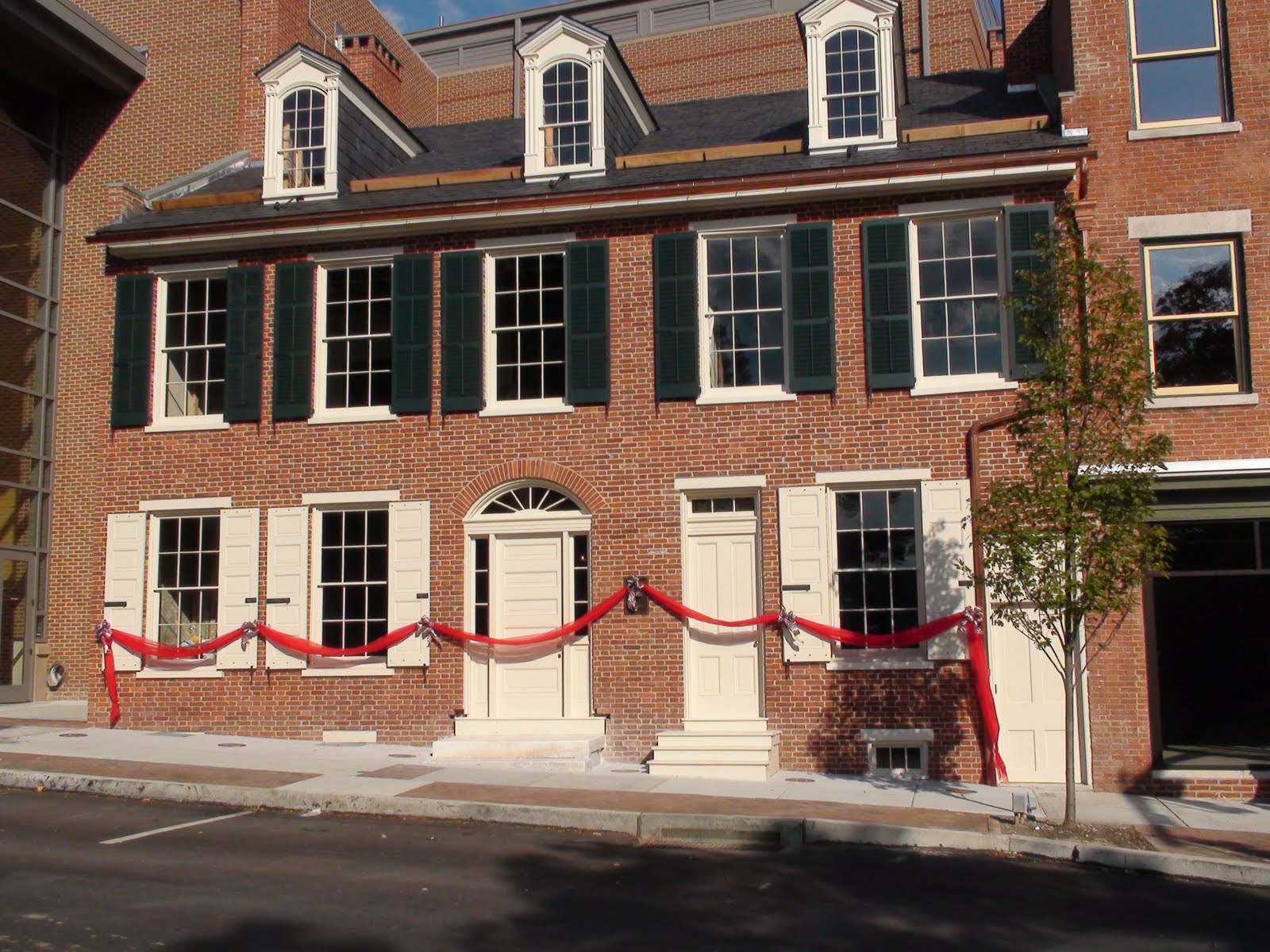
But the really big event is still more than a year or two in the future. That will be when Stevens's house in Lancaster at the corner of Queen and Vine Streets is finally completed after more than 20 years of waiting.

Neglected for over a hundred years, the house was slated to be demolished in 2000 to make way for the Lancaster Convention Center. But Lancaster preservationists were able to save it and restore its exterior to its 1860s appearance. But after fixing up the outside, the effort was put on hold for a decade as other projects took precedence. Now planning and fundraising are in full swing and the multi-million dollar project promises to give the most comprehensive telling of Stevens career and fight for freedom and equality.  

In the meantime, the Thaddeus Stevens Society's collection remains in a residential house with only a few people seeing it. Perhaps some of the artifacts will end up at the Lancaster museum or at other locations that tell the Stevens story. But one thing is certain, the Society will continue to collect Stevens items and press for a Thaddeus Stevens mecca that can be visited by all the Stevens pilgrims. 

Ross Hetrick is president of the Thaddeus Stevens Society, which is dedicated to promoting Stevens's important legacy. More information about the Great Commoner can be found at the society's website: https://www.thaddeusstevenssociety.com/


Sunday, October 2, 2022

The Great Commoner, Fall 2022, No. 45, www.thaddeusstevenssociety.com

 Thaddeus Stevens Society to meet Sunday, Nov. 6, in Gettysburg

The Thaddeus Stevens Society will meet on Sunday, Nov. 6, at 1 p.m. at 27 E. Stevens Street in Gettysburg, PA. The meeting will include officer nominations for the next two years, a report on current projects, a view of the Society's collection of Stevens's artifacts and a walking tour of Stevens's sights in Gettysburg.

The meeting will be a potluck lunch, with drinks, spare ribs and potato salad provided. If you plan to attend, please email info@thaddeusstevenssociety.com or call 717-253-0099 and leave your name and whether you will be bringing a side dish. Members and nonmembers are welcomed. People can park in back of 27 E. Stevens Street and on the street.


Man honors Stevens with leg tattoo that mixes Thad with Terminator


There are many admirers of Thaddeus Stevens, but there is only one that we know of who has has honored Thad with a tattoo on his leg. Chris Beiler, who lives in Akron, PA, has been kind enough to write about the tattoo and how he has used it to teach his children about history.

By Chris Beiler
As an admirer of Thaddeus Stevens and a father of two young children, I often stretch the limits of my kids’ patience and attention spans when I drag them to historical sites, statue dedications, battlefields, and museums. I smile at the idea of my daughter explaining to her first grade teacher that we took a trip to a cemetery just to have her picture taken with the tomb of a man who died nearly a century and a half before she was born. At any rate, my kids have much more exposure to my historical heroes than is probably typical. 

While I hope that these experiences will have a strong impact on my children and on their world, I realize that there is a danger of leaving historical figures in the past. I don’t want Thaddeus Stevens to be just some guy who did the right thing a long time ago. In the minds of my kids, I want him to be someone whose character is a dynamic and inspirational force. Someone who has powerful words for issues that are still relevant today. Thad isn’t silent on today’s issues—we know what he had to say about wealth inequality and public education and attacks on voting rights.

So in my attempts to bring The Old Commoner to life for my kids, I tell them stories of a Thaddeus Stevens: Terminator. He’s a powerful superhero who combines Thad’s obsession for justice with robotic superhuman abilities, and an array of tools that will make short work of the forces promoting or allowing injustice. I ask my kids about the issues in the world that are important to them, and I make up stories of them addressing these issues with the help of a cyborg version of my favorite legislator. The stories are over-the-top and far-fetched. I often shoehorn explosions and daring escapes into situations that don’t really need them. To be frank, these stories aren’t particularly helpful in getting the kids to fall asleep. And it’s true that the real Thaddeus Stevens didn’t need lasers or a metallic skeleton, but the end result is my kids begging for bedtime stories that involve them working to make the world a more just place. What dad wouldn’t make that trade?

To pay tribute to the real Thad and to bring the Terminator version to life a little bit, I had the excellent tattoo artist Alex Zampirri tattoo the fictional version onto me. It’s funny and beautiful and a little bizarre, and it’s also started more than a few conversations about the real Thaddeus Stevens. Most importantly, it serves as a reminder that although Thad isn’t here today to fight for what’s right, we are still inspired and challenged by his example. Long live Thaddeus Stevens.


          Chris Beiler, Melanie Beiler, and children, Harold and Hannah

How the Thaddeus Stevens's Lancaster house should be restored
Thaddeus Stevens's house at the corner of Vine and Queen Streets in Lancaster, PA

     In August 2022, Lancaster Historical Society and its consultant, Ralph Appelbaum Associates, asked for comments on plans for Thaddeus Stevens's house in Lancaster, PA. Stevens Society President Ross Hetrick submitted the following.

The life of Thaddeus Stevens presents a unique paradox to American history. While he never rose to any higher position than a member of the House of Representatives, Stevens exercised power that was equivalent to that of the President and he had an impact on the United States that continues to this day. This can be attributed to the absence of southern representation in Congress during and after the Civil War, Steven’s unsurpassed  parliamentary abilities and  the sheer force of his personality. 


In the new Stevens biography by Bruce Levine, the famous abolitionist Frederick Douglass is quoted as saying this about Stevens: “There was in him the power of conviction, the power of will, the power of knowledge, and the power of conscious ability. . . at last made him more potent  in Congress and in the country than even the president and cabinet combined.” When Stevens died in 1868 his fame rivaled that of Lincoln and major newspapers filled their front pages with his passing. He lay in state in the Capitol Rotunda, and 20,000 attended his funeral in Lancaster – half of them Black citizens. 


But in the decades following his death, Stevens’s fame nearly disappeared. This was partly due to his family and admirers doing very little to promote his memory. The Stevens legacy was also the victim of the “Lost Cause” mythology, which glorified the Confederacy and demonized abolitionists like Stevens. But even as the “Lost Cause” started to fade in the 1970s,  Stevens’s importance continued to be obscured as other Civil War and Reconstructions personalities were elevated at historical sites. .


This is why the Thaddeus Stevens Society was created in 1999 to rectify this situation by trying to secure the recognition Stevens  deserves. Though there have been significant achievements in the past 22 years, such as the erection of Stevens statues in Lancaster and Gettysburg, he continues to be neglected at places where he should be recognized. 


For instance, the National Park Service in recent years has launched a long overdue effort to provide sites connected to Reconstruction. But even though Stevens was a chief architect of Reconstruction, there is no mention of him on the Park Service’s Reconstruction Era website.  Similarly, the Park Service’s Gettysburg museum visitors center, opened in 2008, does not mention Stevens despite the fact the destruction of his Caledonia iron works was the largest civilian financial loss of the Gettysburg campaign.


Therefore, the Stevens Society wants to ensure that the proposed museum in Stevens’s house tells the complete and accurate story of his monumental achievements and is not diminished by other historical matters. It appears that information about Lydia Hamilton Smith and the Underground Railroad will occupy a significant portion of the buildings. And while these subjects were important in Stevens’s life, they should be dealt with in their proper proportion to Steven’s life and great achievements.


Smith was a remarkable woman and was an important part of Stevens’s life, but her accomplishments were not on a scale with Stevens’s. A good comparison of the Stevens-Smith relation is that between President James Buchanan and his niece Harriet Lane, the de-facto first lady during the administration of the bachelor president. She was of immeasurable help to her uncle and worked to have monuments erected to him after his death. Yet, Buchanan and Lane are not treated as equally important at the LancasterHistory’s museum and his Wheatland home.


The Underground Railroad was also an important part of Stevens’s anti-slavery activities. But Stevens was one of thousands of participants in the Underground Railroad and if he had not been involved, it would not have made a significant difference. In contrast, Stevens played a crucial role in the legislative process during and after the Civil War and if he had not been involved, events would have turned out very differently.


With this said, we urge that at least half of the new museum be devoted to Stevens’s legislative career, where he had the most impact on United States history. To do otherwise would give a disproportional view of Stevens’s importance and would continue the marginalization of Stevens’s memory. 


The Thaddeus Stevens Society is very excited about the prospect of a museum that tells the complete story of his amazing career and we stand ready to help in any way we can. And this advice is given in the spirit of providing another point of view that can be helpful in creating the best possible museum.


The McPherson house in Gettysburg and the Second Founding

The McPherson house in Gettysburg, PA, at 250 Carlisle Street


The following letter was sent to Gettysburg College President Robert Iuliano on August 9, 2022 about the historic McPherson house, which is owned by the college and has been vacant for several years. As of October 3, 2022, there has been no reply.


Dear President Iuliano:


Gettysburg College has a special opportunity to create an exhibit to diversity and inclusiveness by using a portion of the McPherson house to celebrate the Second Founding, highlighting the contributions of Edward McPherson, Thaddeus Stevens, Frederick Douglass, Abraham Lincoln, Susan B. Anthony and Elizabeth Cady Stanton. 


The McPherson house is uniquely suited for this purpose because it was the home of Edward McPherson who was at the birth of the Second Founding. As clerk of the House of Representatives in 1865, McPherson worked with Thaddeus Stevens in excluding ex-Confederates from Congress on December 4, 1865. Without this particular action, the passage of the 14th and 15th amendments to the Constitution would not have been possible and Reconstruction would not have happened. December 4, 1865 was the birth of the Second Founding and McPherson and Stevens were the figurative midwives.


The Second Founding has become an accepted designation for the period when the 13th, 14th and 15th amendments were adopted and the United States began the movement towards a more diverse and inclusive society. This historic period has been written about by famed historian Eric Foner in his book, The Second Founding, and the National Constitution Center in Philadelphia has been promoting the concept for many years.


An exhibit about the Second Founding at the McPherson house could serve as an excellent orientation tool for college students about the foundations of diversity and inclusion. It would also attract national attention, making Gettysburg as important to the Second Founding as Philadelphia is to the first founding. Also, since the project focuses on important current issues, it should make fundraising easier.


The Thaddeus Stevens Society stands ready to help Gettysburg College in reaching this very important and worthy goal.


Thank you for your consideration,


Ross Hetrick, president

Thaddeus Stevens Society


Tuesday, September 20, 2022

Thaddeus Stevens Chronicles No. 21

 Preserving Stevens's cemetery -- a national treasure

September 2022

By Ross Hetrick

"I repose in this quiet and secluded spot not from any natural preference for solitude, but finding other cemeteries limited as to race by charter rules, I have chosen this that I might illustrate in my death the principles which I advocated through a long life. Equality of man before his creator."

These are the words carved into the tomb of Thaddeus Stevens. He chose to be buried in the small Shreiner-Concord cemetery in Lancaster because it was the only integrated graveyard in the city when he died in 1868.  He wanted his final resting place to be a testament to his lifelong fight for equality. Yet, even though it is one of the most inspirational graves in the nation, the cemetery is not owned by any group or organization and depends on volunteers to be maintained.

To rectify this sad situation, the Thaddeus Stevens Society has launched an effort to have the cemetery's ownership transferred to some entity and to create an endowment fund so that the graveyard is taken care of indefinitely. It may take years to accomplish, but it absolutely needs to be done.

The cemetery at the intersection of Mulberry and Chestnut Streets in Lancaster is an acre in size and was started by Martin Shreiner, a clockmaker, in 1836. It is filled with some impressive monuments, many more modest tombstones and even an area that is believed to have been reserved for indigent individuals. 

Like many family enterprises, by the third generation, Martin Shreiner's descendants decided they had other things to do and they abandoned the cemetery in the mid-twentieth century. Because it is a cemetery, taxes were not assessed and no government agency acquired the property. Since then the graveyard has depended on the kindness of volunteers and this has ebbed and flowed, leaving the cemetery in bad shape in some decades.

Currently the graveyard is being looked after by the Shreiner-Concord Cemetery Foundation, a volunteer group, which does a good job of maintaining the property with limited resources. The city of Lancaster also lends a hand by cutting the grass. But these efforts could fade away, as they have in the past.

The cemetery is a historical and inspirational treasure that should be preserved by historical groups as well as local, state and federal agencies. If you would like to be part of the effort to help restructure this cemetery, please contact the Thaddeus Stevens Society at info@thaddeusstevenssociety.com

Ross Hetrick is president of the Thaddeus Stevens Society, which is dedicated to promoting Stevens's important legacy. More information about the Great Commoner can be found at the society's website: https://www.thaddeusstevenssociety.com/


Monday, August 8, 2022

Thaddeus Stevens Chronicles No. 20

 Gettysburg College students should learn about Thaddeus Stevens

August 2022

By Ross Hetrick

Hundreds of  first-year students at Gettysburg College trooped from their campus to the Gettysburg National Cemetery on August 25 to hear about Lincoln's immortal address. It would have also been the perfect time for them to hear about Thaddeus Stevens who played a crucial role in the history of the college and the nation. 

As a member of the Pennsylvania state house in 1834, Stevens got the fledgling college an $18,000 appropriation to build the college's first building -- Pennsylvania Hall, the college's iconic building. But Stevens's support of the college provoked a political firestorm. 

In reaction, Stevens said: "Let demagogues note it for future use, and send it on the wings of the wind to the ears of every one of my constituents, in matters of this kind, I would rather hear the approving voice of one judicious, intelligent, and enlightened mind, than to be greeted by the loud huzzas of the whole host of ignorance." This set the tone for the rest of Stevens's life whether it involved promoting education, destroying slavery or supporting women's rights. 

After getting the money, the college had trouble finding property to put it on. Once again, Stevens came to the  rescue by providing six acres at a price determined by the board of trustees. In turn, Stevens was put on the board, where he served for the rest of his life. 

Then in 1854, the college board shocked Stevens by considering leaving Gettysburg. "If the scheme you refer to be real," Stevens wrote a fellow board member, "it is an attempt to violate an executed contract with the people of Adams County and is atrocious." Stevens attended the next board meeting and browbeat the board into agreeing never to leave Gettysburg.

Besides his service to Gettysburg College, Stevens was also the Savior of Public Education in Pennsylvania, Father of the 14th Amendment and one of the architects of Reconstruction. 

Hopefully, either this year or in the future, new students at Gettysburg College will hear about one of the most important persons in their college's history, who was also a national hero.

Ross Hetrick is president of the Thaddeus Stevens Society, which is dedicated to promoting Stevens's important legacy. More information about the Great Commoner can be found at the society's website: https://www.thaddeusstevenssociety.com/